 |
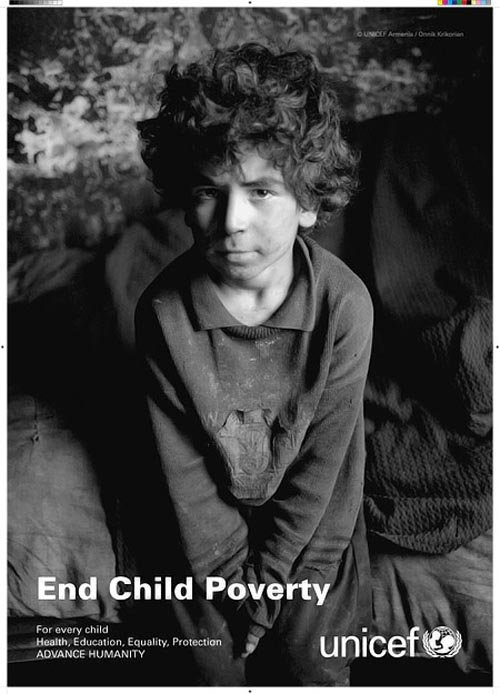
| Unicef End Child Poverty Poster |
Despite a mild economic turnaround, poverty in the United
States is persistent. A new article in the Washington Times estimates that one in four
children are living in poverty in the United States (Washington Times, October
2013). This may have ramifications for child protective services: The
co-incidence of poverty and abuse is well
known (Bower, 2003), and the co-incidence of
poverty and race is even more notorious (Ards, et. al., 2013). Often, the confabulation of race/poverty and
neglect (as well as, but less commonly abuse) produce unfavorable and, perhaps,
unfair results: statistically, African American children are 1.6 times more likely to be found in child protective services and two times more likely to be found in out-of-home placement than they are to be found in the overall population (Ards, et. al., 2013). As Duva and Metzger opine, the well-meaning “edicts of ‘save the child’ with their implied message to ‘punish the family’ have permeated child welfare policy and practice through its transformation from a largely segregated system that excluded African Americans into the present” (Duva & Metzger, 2011).
With little money, there is little room to provide adequate
care to one’s children. Even with the
best of intentions, the poor (and particularly
non-white) populations can become caught up in the child welfare
system, running the risk of losing their children and parents to the foster
system and criminal justice system, respectively (Ards, et. al., 2013). Duva and Metzger
describe the case of an impoverished mother whose crime wholly consisted of her
seven children living with her in a motel room.
The woman could not afford child care or housing and thus had her
children taken away (Duva & Metzger, 2011). Given that child abuse and neglect often
involve both civil and criminal – sometimes felony – charges, a spiral of
poverty can easily end in the twin tragedies of children in foster care (a
vulnerable situation commonly resulting in additional abuse, neglect, and
instability) and a parent in prison.
 |
| Imprisoned mother visiting with her child |
In short, what we define as neglect - particularly in
situations of abject poverty – may indeed be racialized or at least based on a
model of parenting that is structured for the ideal, not the real. When the effect of an allegation of neglect
is to separate parents and children, place working parents in jail, and send
already vulnerable children into the foster care system, we need to seriously
consider whether we are protecting children or punishing poverty and African
American working motherhood.
Particularly in this time of national recession and widening income
gaps, we need to ensure that parents and children living in poverty are not
criminalized and separated but nurtured and protected. As public health advocates, we should be
sensitive to any process that criminalizes poverty and – by design or
consequence, minority status - instead of addressing the poverty itself.

Perhaps you are correct. The way the justice system works today in these instances only points the finger and does nothing to create a solution. Not only are you punishing the mothers for a lack of resources but the children are the true victims. Having two foster brothers of my own, I realize that it is not an easy task to get out of the foster system we have today. I'm almost sure it would be cheaper to support the mothers in a way that assist her out of poverty than to make them a criminal and support them in prison.
ReplyDeleteCaitlin this is a great piece of the conversation to have when considering child poverty. I was reading through some of the studies you provided and while reading the Duva and Metzger article I was blown away at the statistics highlighting the disparity in representation of different racial groups within instances of poverty. Their study was drawing on statistics from very recent studies (2007 & 2009) and it was still found that the rates of African-American children living in concentrated areas of poverty with lack of most all resources (affordable housing, education opportunities, healthcare access, etc.) was more than four and a half times greater than that of White children who were also living in poverty. It grips me to see recent statistics like that, and how it so clearly shows the institutionalized racism within the poverty continuum.
ReplyDeleteGreat topic Cailtin, and I agree with J.T, it is hard to get out of the foster system. My aunt and uncle who live in northern Michigan are foster parents and they always worry about the future of their foster kids. When I went to Western Michigan University, I worked in the Office of Admissions. We had a special program for students who grew up in the foster system. If they qualified, the students could receive a scholarship covering 100% of their tuition and housing (on campus). I am unaware whether other colleges and universities offer this type of scholarship program, but I believe it is a wonderful opportunity to help these young adults continue their education.
ReplyDelete