In the Washington Post, an article regarding advancements in Prenatal Genetic Testing readdressed the long-standing debate regarding how much information about fetal development is too overwhelming for expectant parents (Winerman, 2013). The goal of prenatal genetic testing is to screen fetuses of disabilities that can negatively effect their futures (Winerman, 2013).
 |
| Designer Babies |
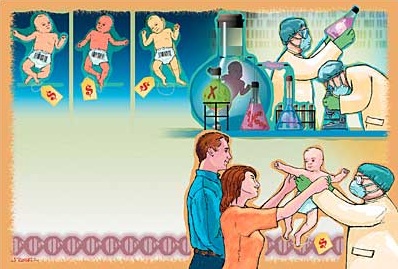
Chromosomal Micro-array Analysis (CMA) is one of the newer advancements of genetic screening that is available to high-risk pregnant women. The technique used in this screening tool collects fetal DNA and codes the strands to find genetic inconsistencies. This technology will allow parents to screen their children for genetic disorders like Trisomy 21 and for social disorders like autism or schizophrenia (Winerman, 2013).
According to a study implemented by Stark, Gillam, Walker & McGillivray (2013) Chromosome Micro-array Analysis (CMA) has now become the standard of chromosomal testing. It is now considered safer than the traditional karyotype testing such as the amniocentesis and provides more information. All the while, it can cause extreme distress to parents due to diagnoses of genetic issues with their child (Stark, Gillam, Walker & Gillivray, 2013).
In the Winerman (2013) article, parents who knew more about their unborn children showed higher signs of emotional distress based on the test results. One mother discussed how her inconclusive test result gave her anxiety. Despite her son being born without physical ailment, this mother is still concerned that the uncertain test result could identify an unknown disorder (Winerman, 2013).
 |
| Eugenics |
Currently, in my Community-Based Clinical, I am placed at the Jewish Family Services Center. In the Jewish community, advancements in genetic testing can be beneficial and simultaneously concerning. Many Jewish families are already aware of genetic disorders that are prevalent in their community such as Tay Sachs Disease and Cystic Fibrosis (Jewish Genetic Disease, 2013) . Yet, this preparation in many cases does not protect the parents from moral dilemmas.
Additionally, these new technologies can be difficult for the Jewish community as well. The ideas of genetic selection and screening of life can be viewed similar to Neo-Nazi philosophies. Genetic Testing is purposeful, but if not controlled it could lead to dangerous implications. Speaking with Holocaust survivors in my clinical brings my attention to the idea that concepts like "healthy" "perfect" and "normal" are all subjective and can change with time. Hopefully, in our time these concepts will not become weapons against humanity.

I was just talking about this topic with some friends last weekend. Although I know that many people are skeptical of a world where we know more than we should - that is, that we fear the known rather than the unknown - I believe that some prenatal and early postpartum tests are extremely beneficial. During my time working for a midwife, we encouraged all our patients to participate in the Newborn Screen test. This test screens newborns for metabolic disorders such as PKU. The purpose of the test is to detect these disorders as early as possible, supplement the baby's formula accordingly, and prevent negative or even fatal symptoms from occurring. This test causes anxiety for many of the parents, as does most health screening. However, I believe that fear cannot be the driving force behind avoiding such health promotion. It would be interesting to conduct a study on the kind of anxiety and depression that occurs when parents must reckon with a child's illness, especially if the illness could have been avoided with a simple test and nutritional intervention. I know that many people view this type of health care as modern-day eugenics, but I believe that many of these tests are capable of preventing children from suffering unnecessarily, assisting parents in assisting their children, and avoiding enormous health care costs.
ReplyDeleteWhenever a major advancement in technology is developed, especially if related to healthcare, I think we as a society instantly overact by thinking of extreme future possibilities that could result. For this reason I can understand why several people may consider this new technology as a step toward eugenics. This topic reminds me of the 1997 film Gattaca, which depicts a world in which eugenics is the norm. Those who are born naturally are discriminated against and are considered inferior. Currently CMA is only a screening tool to detect fetal abnormalities. Imagine if CMA could empower parents through the detection of diseases, or even someday mental health disorders. For example, if a couple knew their child was at risk for depression, they could provide early intervention by ensuring a positive attachment is made with the newborn. As the child grows early psychotherapy, cognitive-behavioral therapy, and even medications could be utilized before such a disorder has a chance to make a negative impact on the child's life. One issue that could arise as a result of using such a screening tool is making it available and affordable to everyone who wishes to use it. Interestingly, this is the question our country faces today with regards to health issuance.
ReplyDeleteKenyatta, this post brings a lot of thoughts and a good discussion to the surface. I understand that the fear of the unknown is daunting but if you are old enough to choose to make a baby, you should the the child no matter what. I think genetic testing can be beneficial if certain diseases run in the family, but not to create a specific child you want. The whole term "designer babies" makes me extremely upset because dominant and recessive genes are there for a reason. If you start choosing what traits you want in your offspring, the gene pool gets messed up. In the case of Tay Sachs which is a horrible disease and the child is not going to live to the age of 10, maybe not even 5, parents really do have a moral dilemma. If they know their child will die if it is born, is it worth that child's pain and suffering? If I were in their position, I am not sure. But as technology advances, we will be seeing more ethical dilemmas occur. I do not think fear should control our world.
ReplyDeleteKenyatta this is a very thought provoking topic. A part of me feels that genetic testing takes away from the miracle of life but there is a part of me that likes to have all the information available to me. But like Shannon, if I were in the position I'm not sure what I would do. Ethically, what is the responsibility of the healthcare provider in this situation as well? If a parent were to find out their child has Tay Sachs it would be the responsibility of their healthcare provider to educate the parents and give options. I think it is also particularly interesting that you mention "designer" babies. To what extent will we go to find out information. I think this goes back to the instant gratification that is often sought in our American culture. It once was impossible to even know the sex of the baby prior to birth, now I often find myself shocked when people don't have this information prior to their child's birth. Will there be a time where is it expected that parents will know all of their child's characteristics prior to birth?
ReplyDelete